Guides
Assess a high dress slit before closing the seam
If a dress slit feels too high, compare standing, sitting and ordinary steps before choosing a repair. Closing part of the opening can improve coverage but may restrict a narrow skirt. A repairer should inspect the seam, lining and reinforcement before promising a new opening height.
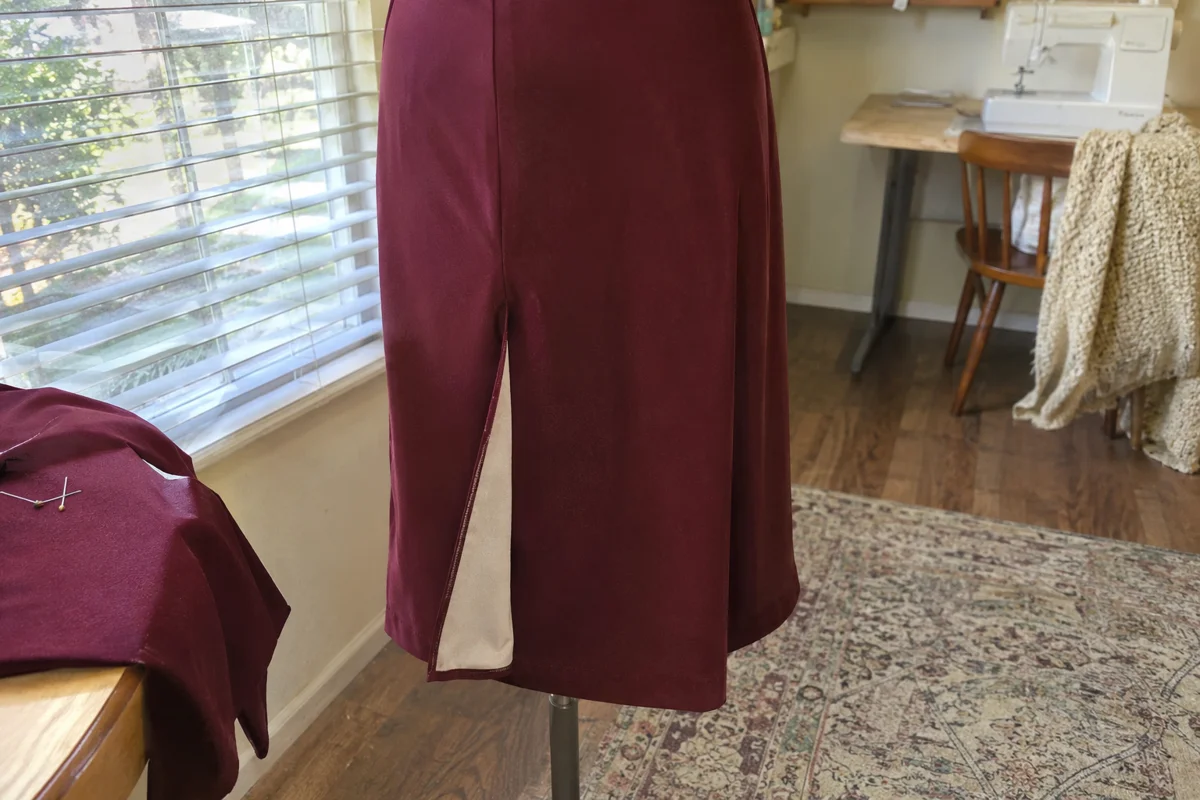
If a dress slit feels too high, check it standing, seated and during an ordinary step before choosing a repair. Closing part of the opening may improve coverage but can restrict movement in a narrow skirt. Ask a repairer to inspect the seam allowances, lining and reinforcement before promising a lower opening.
What does too high mean for this dress?
Start with the coverage you want for the actual occasion. Put on the shoes and underlayers you intend to wear, let the dress settle and check where the top of the opening sits. Keep that preference separate from whether the dress is the correct size. A slit can be deliberately high in an otherwise comfortable garment; another opening can spread because the skirt pulls across the hips.
Our dress measurement guide provides the wider fitting context. A hem length alone does not describe the exposure at an opening. Photograph the skirt standing normally without pulling its sides together for the picture. Check the same view after a short walk.
Is it a slit, an overlapping vent or a wrap?
Look inside with the dress off. A simple slit has separately finished edges below a seam. An overlapping vent has additional fabric arranged to cover the opening. A wrap may open because two larger panels overlap rather than because a seam ends there. The slit and kick-pleat comparison explains why these constructions need different assessments.
The Sewing & Craft Alliance slit guide illustrates finished edges and reinforcement at the upper end. That construction matters when moving the point where a slit begins. Existing reinforcement should not simply be cut out of a finished dress to make the opening look different.
Use a three-position coverage record
Record what you see standing, seated in the kind of chair you expect to use, and taking a normal step. Include a modest step up if the event requires stairs and the movement is comfortable. Do not perform a wide lunge to prove that every dress needs a large opening. Note whether the slit spreads, the skirt rises as a whole or the lining catches.
| Observation | Question to resolve |
|---|---|
| Opening already above your preferred point at rest | Can some of the existing seam be closed without restricting the skirt? |
| Edges spread only while sitting | Is there enough room across the seat and hips? |
| Lining appears before the shell opens | Does the lining opening match the outer construction? |
| Top of opening looks torn or newly higher | Has the seam failed rather than been designed that way? |
| Wrap separates during walking | Is the panel overlap sufficient for the movement you need? |
Keep a short note of which position changes the result. A repair brief that says the opening exposes more than you want when seated is more useful than a request to close an arbitrary number of inches.
Can you sew part of the slit closed?
Sometimes, when the existing seam allowances and skirt width permit it. An alterations specialist can assess the remaining cloth and finish. Seacoast Seamstress describes closing some formal-dress slits as a possible service; that is an example of the work, not a guarantee that every dress can be closed to any height.
Ask for a provisional fitting before permanent stitching where the fabric allows one. Pins must be removed before you walk or sit. A professional may use suitable temporary stitching for a controlled fitting instead. Repeat your original movements and stop if the fabric strains. On a narrow nonstretch skirt, closing the slit completely can remove the clearance that lets you walk.
An illustrative request might be to close 4 cm of an existing opening. The useful result is not the number alone: it is whether the new starting point gives the coverage you want while preserving movement and a sound seam end. Confirm the proposed finished position and the reinforcement with the repairer before work begins.
What if closing it is not the right repair?
A matching or intentionally contrasting inset can sometimes add coverage, but it changes the look and requires a suitable attachment. A vent conversion needs fabric for an overlap. The Burda-hosted Jenny vent tutorial changes a pattern by adding an extension; it is not evidence that a finished dress already contains that spare cloth.
Ask to see any proposed inset fabric beside the dress in daylight and against its lining. Check weight, opacity and drape rather than color alone. A slip can alter what is visible beneath an opening but does not reconstruct the outer skirt. Fashion tape is not a replacement for a structural seam or enough walking room.
Check the whole garment after the alteration
Try the dress with the same shoes and underlayers used for the first record. Repeat standing, sitting and stepping. Check the new seam end for strain, the lining for pulling and the outer edges for an unexpected pucker. Our seam surface guide helps describe that last concern without pulling the cloth flat.
Keep the before-and-after notes with the repair receipt. If no feasible alteration gives both comfortable movement and the coverage you want, another dress can be the practical choice. The goal is a garment you can wear through the event without continually holding the opening closed.
Keep reading
 Guides
Kick pleat vs slit: what your dress opening actually does
Identify a dress slit, vent or folded kick pleat, then check normal movement and coverage with two practical decision aids before an event.
 Guides
How to Measure Yourself for Dresses and Jumpsuits
Measure bust, waist, hip and length correctly, then use the size calculator to find the size range to start with for dresses and jumpsuits.
 Guides
Dress Codes Decoded: Black Tie, Cocktail, Smart Casual and More
What black tie, cocktail, smart casual, business casual and festive attire really mean, with examples and a flashcard quiz to test yourself.